A transparent process
We share deliverables at every stage and move on only after your sign-off.
Steps
- 01
Consultation
We clarify goals, budget and timeline together.
- Deliverables
- Quote and proposed schedule
- What you do
- Share your service goals, required features and reference materials
- 02
Planning
We finalize feature specs and screen flows.
- Deliverables
- Feature specification and screen flow diagram
- What you do
- Review the specification and confirm the feature scope
- 03
Design
We create UI mockups and a design system.
- Deliverables
- UI mockups and design system
- What you do
- Give feedback on mockups and provide assets such as logos and images
- 04
Development
We share the schedule and deliver tested builds as we develop.
- Deliverables
- Development schedule, tested builds
- What you do
- Review tested builds and share feedback
- 05
QA & review
We verify quality through QA and your review.
- Deliverables
- Test results and change log
- What you do
- Final review and approval
- 06
Launch & maintenance
After deployment, we keep operating and improving your service.
- Deliverables
- Production deployment, handover of source code and documentation
- What you do
- Prepare operational details such as domains and store accounts
We test in an environment that mirrors production
Just like production, we run the web, admin and API servers behind a reverse proxy on Ubuntu Server and test them there. Builds and deployments are automated with Jenkins so every release follows the same steps, and we track availability, response times, 5xx errors and resource usage in Grafana to find problems before real users do.
A real dashboard
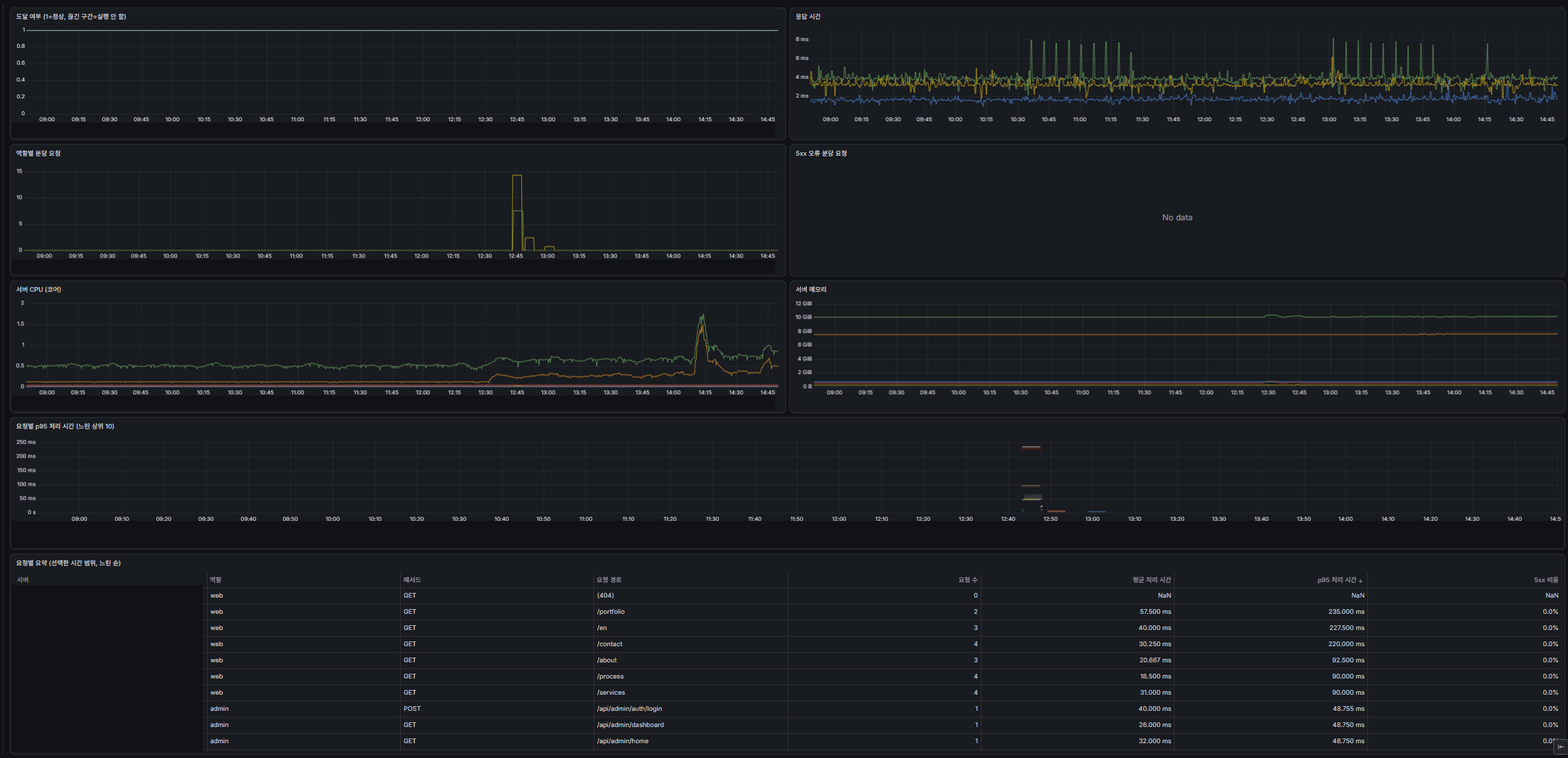
What we watch
- Server CPU, memory, disk and network
- CPU and memory usage per container
- Availability and response time of the web, admin and API servers
- Requests, status codes and processing time per URL
One consistent view
- Dashboards managed as code, so every server shows the same view
- Pick a test server and compare metrics before and after a deployment
- Metrics collected every 30 seconds and kept for 90 days
Problems caught before launch
- 5xx errors, refused connections and responses slower than 5 seconds
- p95 processing time of the 10 slowest requests
- CPU and memory trends after each deployment
Frequently asked questions
How is the cost estimated?
We estimate based on the amount of work — feature scope, number of screens, external integrations and so on. After defining the scope in a consultation, we provide an itemized quote. Consultations and quotes are free.
How does the contract work?
Once we agree on the quote and schedule, we draw up a contract covering the scope of work, schedule and payment terms. If needed, we can also sign a non-disclosure agreement (NDA) before the consultation.
Who owns the source code?
When the project is complete, we hand over all source code, design documents and deployment details. Ownership of rights is specified in the contract, and we work so that you're never locked in to a single vendor.
What about maintenance after launch?
During the free stabilization period after launch, we take responsibility for resolving early issues. The length of the period is agreed based on project size; after that, we support you with a maintenance scope and cost tailored to your needs.
Can I get a consultation without a set budget or timeline?
Yes — an idea is enough. In the consultation, we'll clarify your goals and priorities together and propose a scope that fits your budget.
Planning a project?
No fixed budget or timeline yet? That's fine — start the conversation with just an idea.